Thursday, September 22, 2011

Biking, Bainbridge Island and Blackberries

After the second brilliant sunny day of this trip and the 8th consecutive sunny Seattle day, I'm beginning to suspect that all those continuous rain stories about the Pacific Northwest are told in order to keep Californians and Easterners away. Another thing that would be attractive, if you knew, and they've never mentioned, are the blackberries. You know those rather largish black berry bundles that grocery stores sell in tiny pints for $3.99? Those same berries, or rather, a more luscious, ripe, version of those berries grown EVERYWHERE in the Pacific Northwest.

I first noticed them, with the total disbelief of a blackberry deprived Northeasterners, as we were riding our bikes just outside of Bainbridge. We'd taken the 9:20 ferry, arrived just a little before 10:00, rented some horrendous rental bikes (I now get why some people don't like to ride bikes, I wouldn't either if this way my experience) and immediately pedalled out to circumnavigate the island. After grinding through 6 gears and 2 chain rings up a hill, we were speeding down when I noticed that all those bushes crowding the side of the road were overflowing with blackberries. I braked. SD swore, almost ran into me, and narrowly avoided another broken collarbone which may be the reason he was not as impressed as I was. There were blackberries everywhere.

At least they sure looked like blackberries, but what were blackberries doing on the side of the road? Unpicked by humans, untouched by birds, unnibbled by rodents? I glanced up the road to see if anyone was watching, any cars approaching. The coast was clear so I picked and ate one. At this point I was expecting that perhaps they just looked like blackberries but were infact some insidiously disguised poison fruit. But oooh, they tasted like black juicy sweetness itself. I picked another and handed it to SD, hoping it would justify his close encounter with 3 months of intense shoulder pain. I'm not sure it did, but he did smile. We ate some more, me still glancing furtively around wondering when some angry farmer would appear waving a shot gun, and then we rode off.

BLACKBERRIES!!!!
Up over the next hill there were more roadside berries, and up the next hill, and down the other. (In addition to berries there were an unexpected number of hills on this island!) Sometimes the bushes looked so ripe and full I tried, but just could not pedal by. SD was now riding a good 100 ft behind me so when I cried “Berry Break!” he would have enough braking distance. At one patch I was literally surrounded by blackberries, so many berries, so little hunger.

Talking about this later with Pacific Northwesterners, transplants, and other visitors, I learned this first encounter with blackberries was typical. That they are in fact so plentiful as to be considered an invasive weed. The bushes are everywhere, in highway medians, on the side of the LinkRail tracks, in vacant warehouse lots, in parks, everywhere.

Strangely enough, they still sell in Seattle grocery stores for $3.99 pint.

Monday, September 19, 2011

Swimming with the Salmon, Hanging with the Harbor Seals

Most people go to Anacortes to see the Orcas. And I admit, that would be cool, but on Friday I went to Anacortes to see the Salmon and the Mussels, or really, the Salmon and Mussel farmers.

Riding to the Salmon Farm
Ever since I was a kid I wanted to be a farmer. But being raised in a coastal fishing village, farming seemed remote, exotic and impossible. Little did I know, I could have been a fish or seafood farmer (there presently is a oyster farm in Noank) . Aquaculture in the United States is amazing.  While its image suffers from the bad rap it gets from foreign raised salmon, US grown fish thrive in open, healthy, sustainable 'farms.'  Farms that I'd be happy to live on. While America romances the Family Farm of the midwest, with its rolling fields of amber waves,  I've seen the beauty of the Peuget Sound waves rolling beneath Mt. Baker and douglas fir lined shores.

Mussel Farmers Hard at Work
And then there are shell fish farms. From Anacortes we drove about 20 miles south to the Penn Cove Shellfish Farm and toured the mussel farm.  The mussel are grown on 30 ft lines hanging from a series of rafts.  Apparently, the harbor seals consider this their personal day spa. Even as we rode by them close enough to almost touch the raft, they merely glanced our way and went on sun bathing. There's an amazing amount of work that goes into profitably growing and harvesting mussels. The day we were there wasn't a harvest day but there were still two crews hard at work. One 'socking' the young mussels onto their lines and the other gathering spat.

The only proper way to end a day of watching people grow food, is, of course, to consume that food. Coincidentally, just down the road from Penn Cove, in the town on Coupeville, is Toby's Tavern,  the perfect place for mussels and beer.

Monday, September 05, 2011

Kayaking the Ipswich River

Cardinal Flower
There just might be something to this river paddling. While the boats need to be a bit shorter, and you have to contend with  more bugs, incessant turning, and submerged logs, you never have to wonder if the tide is going to turn on you and leave with all your water.  In fact, if you start up river and paddle down, you're guaranteed to have more water the longer you paddle. And, the big bonus - you really don't even have to paddle, the current just floats you along. The run between Thunder Bridge in Topsfield, Ma and the take out in Ipswich is probably 9 miles, and it only took an extremely leisurely 4 hours.

The river, roughly splits into three different areas, although throughout the entire length it meanders continuously bringing you, after half a mile of paddling, just a few feet east of where you used to be.

Through the Audubon
The first section of the run however, from the put in to the Audubon Society land, reminded me of paddling in Ocala National Forest. It was about as much like the Everglades as you can get in New England. Lots of vines, cardinal flowers, clear water over sandy bottoms, submerged logs and people, in the middle of no-where, bathing. (Not swimming, but lathered up with soap and bathing).There was a blue heron who proceeded me for about an hour, flying down river, or across to the next oxbow until I paddle up, when he would take off, and move on down.

The second section was through the Audubon Society land. More meanders, but through a very open marsh. Very few trees, and very little dry land. It was a sunny day, one of those sunny days where you pray for a cloud, any cloud and paddling through an open marsh provided no relief. The turtles however, were not complaining and they were everywhere basking on the logs they were pretending to be.

Grape Break!
The third section, was the shortest. From Bradley Palmer State Park to the take out, the Ipswich River runs through a more forested section with willows and other trees over hanging the banks, and lilies in the water. In some places there were also grape vines, and some of those vines had juicy bunches of Concord Grapes! It's been a long, long time since I've picked a ripe bunch of Concord Grapes off a vine and eaten them. And oh, they were good!! The kayaking was great too. The river was just woshing along, and while the grapes were good, I was getting hungry. It was that time of the paddle when you starting thinking about food and beer. And that's just when the take-out appeared around the bend.


Saturday, August 06, 2011

Midsummer's Night Bike Maintenance


After a long first half of the riding season and with the cool fall rides to come, my Puck has come to put the bikes back to rights.

Regular maintenance requires some regular tools and this time, rather than hang the bikes off the back-of-the-car bike rack we thought it time to get a Home Mechanic Repair Stand. For reference, Puck uses the Park Tool BBB-2 The Big Blue Book of Bicycle Repair - 2nd Edition. He's not sure if he needs the Park Tool Advanced Mechanic Tool Kit, seems like it'd be better just to buy the tools we need, when we need them. Of course I already have the  Park Pedal Wrench (which has been to Holland, Belgium and Luxembourg), a Chain Tool , a spoke wrench and the ubiquitous, ever-useful Muli-tool. What more could you need? (oh, Puck says you also need Tire Levers)

And while Puck is busy fixing, I'm just going to buy things. Like a new set of Time Iclic Cleats. I love the Time i-Clic Pedal. They are really easy to get in and out of and give just the right amount of play. The cleats however, wear down really fast. I try not to walk in them too much but after a little over a year, it is well past time to replace them.

If we the bike professional have offended,
Think but this, and all is mended,
That you may ride your bike so dear
But until thou does repair it, it is clear
That all between you and machine
May appear no more than a dream,
Gentles, do not reprehend:
if you pardon, we will mend:
And, as he is an honest Puck,
The bike will run years more with luck.

Thursday, August 04, 2011

The Good Part of the Commute

This video captures the best part of the commute from Boston to Manchester. The last 5 minutes (cut down to 2) Shot today. I haven't figured out how to edit out the sound so you might want to mute it.

Sunday, July 31, 2011

My New Place of Employment - Alt Resume


I can now add 'Kayak Guide' at Essex River Basin Adventures to my alternative resume, right after 'Gear Guide' at Eastern Mountain Sports, which follows 'Boatyard Worker' at Noank Shipyard.  Not bad for a computer geek/librarian!

Kayak guiding is a good gig. While you don't get to talk with customers about all kinds of cool gear like an EMS guide, you do get to take them out on the water in one of the most beautiful estuaries on the East Coast and show them how to paddle a sweet little boat through brilliant marsh land, and share with them the egrets, ospreys, plovers, crabs, fishes, and clams, along with talking with them about the history of Choate/Hog Island and the Crane Wildlife Refuge.

And, as at EMS, one of the best part of the job is the other guides!

If you're ever on the North Shore (the shoreline area North and East of Boston) look me up and we'll get out on the water.

Friday, July 15, 2011

New Tour de France Scenario


Only one week down and this year's Tour has already inspired a new wannabe-rider scenario. Now in addition to practising my stage winning finishes (hands raised straight up,to the side, or mid-way, or the self-congratulatory chest bump), and the effortless spin through fields of sunflowers/corn/hay, or raising my hand when flatting so the team car can zoom up and replace my tire, stage 9 has given me a whole new scenario.

Now, when being passed by a car on a twisting, narrow road I can pretend that the car is being driven by a thoughtless French newspaper driver who may side-swipe me and throw me into the bordering barbed wire fence ala Johnny Hoogerland.


Really, it is time for every car and motorcycle driver to realize that bicyclist are people. They're flesh, blood, and muscle, and when you hit them with a heavy hunk of moving metal bad things, very bad things are going to happen.

Tuesday, July 12, 2011

Ode to the Camp Counselor and Kayak Guide

One of the notable things about the other week's hikes was the number of camp groups on the trails. Groups of kids, aged 11-17, originating from some camp somewhere in New Hampshire, out on a day or overnight hike accompanied by one or two young adults,

For many of these counselors, you could tell that running these trips was both a privilege and a challenge. For many of the kids, you could tell this was their first trip into the woods and while they chatted on about Nintendos and facebooks statuses they'd also stop to admire the views, and play in the waterfalls. And even though the camps attempted to match up the skill level and fitness of the kids there were still ones that would go bouncing off the front, and others lagging behind. The Counselors, did a good job of keeping everyone together and keeping the mood up.

On a related note - yesterday a large group of kids went out with the Essex River Basin Guides. It was a beautiful day and while, I can only image what its like to go kayaking with 60 kids, I'm sure the guides made sure they had a great time and were safe, as well.

For many of these kids, this was probably their first experience in the Whites, or on the water, and it was good to know that these important first introductions are handled so well.

Tuesday, July 05, 2011

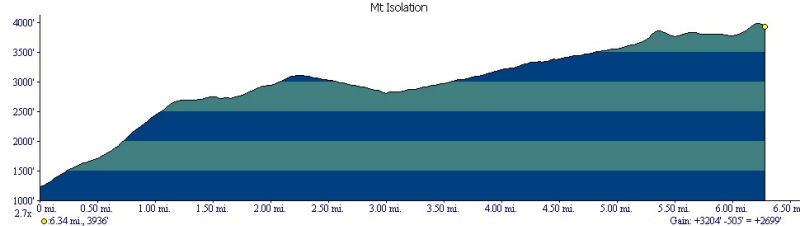
Mt. Isolation, Moose and Iliotibial Band Syndrome

12 or 14 miles (depending on which trail you prefer) deep into the White Mountains lies the appropriately named Mt Isolation. One of the shortest, but furthermost from any trail head, of the 4000fters. (Owls Head is 16 - but that's a hike for another day).

We decided to walk in via the Rocky Branch trail this time, having attempted the Glen Boulder trail earlier. Certainly not as scenic, but promising 1000ft less in elevation and the chance to take a dip in the Rocky Branch river if the temps rose to the predicted 80 degrees. The trail rises up immediately off the trail head and continues a steady, but not stair-like climb for the first 1.8 miles before almost leveling off for a 0.9 mile stretch down to the river. Around 1.6 miles we paused to have a staring contest with a moose.  Despite numerous and voluminous evidence that they are everywhere, we've only seen two moose in our hikes. Both times they were just off the trail, behind some brush. Both times they just stood and stared  at us. This time we stared back, S.D. took some pictures, we all stared some more, the moose won and we continued on our hike.
Moose do not photograph well

Around 2.1 miles the right side of my right knee seized up. Iliotibial Band Syndrome usually happens to runners but it can happen to anyone, especially folks who "are notoriously weak in their hip and core muscles, particularly if strength training or participation in sports that involve side-to-side movement are lacking." - umm like cycling. And it's happened to me before. Usually on the final mile of a long downhill stretch - not less than a 1/4 of the way up on a 14 mile hike. S.D. whipped out his first aid kit and expertly wrapped my knee. Hoping that a walk on the upcoming flat and the bandage would keep things under control, we continued along. But things didn't improve and as the trail became a stream and hiking became an act of jumping from one rock to another the knee really started tightening up. At the Rocky Branch River the knee and me just snapped. Frustrated by having hiked the hardest part of the trail, even now being able to see Mt. Isolation, but knowing I couldn't reasonably continue on, I gracefully hurdled my hiking poles into the dirt, and let loose with a string of expletives that S.D. will forever tease with me but that at that moment were pretty shocking.

After I finished my little tantrum we turned around, hiked a little, had another peanut butter and jelly sandwich that couldn't be beat, and limped on back to the car. We'd hiked 7 miles, it was a beautiful day, the last day of a great vacation and we still had 5 more 4000fters to go, 5 more easy reasons to return to the White Mountains.

Monday, July 04, 2011

Liberty and Flume : And then there were five

Friday morning was foggy and the forecast called for rain, but since it just can't be a hiking vacation unless you climb in the rain we went ahead with our plan to take the Liberty Spring trail up to Mts. Liberty and Flume. And it's a nice trail, provided you don't mind walking up stairs for 1.6 miles and 3000 ft.

Along the way we stopped and talked with two AMC guys who were putting in some erosion ditches.  Brian was a lead maintenace guy and went around to the various crews providing technical knowledge and oversight. Jim was the caretaker at the Liberty Springs tent site who like other caretakers also cared for the trails nearby. Being a high traffic trail (Liberty Springs is also the AT), and very steep, the trail is constantly eroding and while the majority is passed over the granite/dirt combination so common below treeline in The Whites, there are also some sections of crumbly brown sedimentary rock that easily washes out. As S.D. pointed out - most people think all the trail work, those finely crafted log and stone steps are for the hikers but really they're for the trail. To keep as much dirt and rock on the mountains for as long as possible.


A few hundred yards after chatting with the guys (and catching our breath) we reached the peak of Mt. Flume and soon after were back on Liberty. Our last peaks in Franconia Notch. There were nice views off both and the rain held off until we were half way down. Making a nice hike for us, and the promise of more work for the trail crews.

Sunday, July 03, 2011

Mt. Lincoln – Being there (7 to go)


So far in this quest to hike the 48 New Hampshire Mountains above 4000ft I’d managed not to get obsessed, to view the hikes more as a relaxed itinerary than as a means to accomplish a goal. To take each one on its own, and enjoy it.

Standing on the peak of Mt. Lincoln at 5087 ft, and in the middle of the Franconia Ridge trail, one of the most beautiful trails, I caught myself calculating whether or not it would be ‘worth it’ to reverse direction, add a few miles to today’s hike and bag Mts. Flume and Liberty instead of continuing North along the ridge to Mt. Layfette, one of the most amazing hikes in all of New Hampshire. With only 7 peaks to go – my obsessive nature was kicking in – Big Time.

Here I was, on a trail I’d dreamed of hiking since I first saw it four years ago, on a beautiful day, and all I was thinking of was getting off it, and on to the next peak(s). If I could get those other 2 today, that would bring the total remaining to 5. An easily doable number by August and my 50th birthday.

But then a vulture drifted by on the updraft, a small tuft of flowers growing in the small protection offered by a granite boulder, and the look on the face of a passing hiker all brought me back. To where I was.

Wednesday, June 29, 2011

Caps Ridge Trail – Climbing Mt Jefferson

We were lucking out. Our first day in the mountains and all was going in our favor. The road to the trail head had been opened that morning, the sun was shining for the first day in a week and we only had a 2.4 mile, 2000ft hike to the summit.

The first mile of the Caps Ridge Trail climbs straight up through dense forest then opens out just below the first Cap. From there you could see

everything. From Vermont to the west flank of the southern Presidentials, to the summits of Mt. Washington and Mr. Jefferson. We could also clearly pick up the trail, and all the Caps between us and that summit.


The trail descriptions mention the glacial bowls occurring in a the large boulders just inside the tree line, but geologically what really stands out, for me, is the massive jumble of volcanic rock that make up the summit cone. Lots of lots of sharp, bumpie igneous rocks, three conglomerates of which have been named “Caps” and then just lots, and lots, literally a boulder field of others. Jefferson’s summit being the tallest pile.

We made it there in good shape and took a scenic route down to the Gulfside trail and around through the alpine meadows. A perfect start to the week, and only 8 more 4000fters to go.

Monday, June 20, 2011

The Reluctant House Hunter

The Hubba Hubba
 We've been stalking 'the perfect home' for the last six months. An amazing fact in and of itself because since selling out of my last one, I've been a very happy, care-free renter. The prospect of being tied to or owned by a solid architectual structure on an improved piece of land doesn't appeal to me half so much as the ability to throw what little I have on a bike, kayak or car and go, sans worry, into those wonderful un-improved places that still exist, leaving as little trace of my passing as possible.

But in the interest of being able to maintain the carefree, low-impact life long into the future, it appears that the best plan at present is to a get a house.

not the actual house
So we've been hunting. Hunting with very specific criteria. Stalking not just any house, but intending to bag the Big One. Domesticus Dralvius. 2 or 3 bedrooms, 1 or 2 baths, 1000-1500 sq ft, in a quiet location within walking distance to the commuter rail and a short drive to Gloucester, with a 1 or 2 car garage/toy box, that doesn't need a lot of work.

Elusive prey, to be sure. But given this market, this time of year, and a recent expansion of the hunt zone, this weekend we cornered two.  Haven't bagged either yet but it feels unexpectedly comforting to be close.

Thursday, June 09, 2011

New England Flatlander Microclimates

Tuesday afternoon I went from 85 to 55 in 1.6 hours and a drysuit. Boston was hazy, hot and humid when I boarded the Rockport Express to Manchester (By-the-Sea). 50 minutes later I stepped onto the platform and into a sunny, summer afternoon. Not too hot, not too cool, with just the slightest of on shore breeze. From there to Conomo Point took less than 15 minutes. A simple flip of the kayak later and I was enjoying the refreshing 55 degree water of the Atlantic Ocean.

Tuesday morning I had been speaking enviously of the microclimates of the Southwest. Of how wonderful and unique it was to escape the desert heat by hiking down into a slot canyon or climbing up a butte or mountain a few thousand feet to experience a cooler weather zone.

Heck, I've even bemoaned being away from the zones of the White Mountains.

Today I realized that I live in the middle of the New England Flatlander Microclimate with weather variations all around, and down.

Thursday, June 02, 2011

ERBA Guide Shoals

photo by Carrie
The US Hydrographic Office in association with NOAA, announce the amendment of chart 13279, to include ERBA Guide Shoals. Located .4 miles East of the South end of Crane Beach, the Shoals present a significant hazard to kayakers and operators of other inshore small craft.

Breaking waves form over these shoals without a moments notice, taking paddlers unawares and indiscriminately knocking them, and their rescuers over. Once over, kayakers are advised to "get in your  boat". While others are to continue paddling, even as such activity will not move them forward, and to keep an eye for the formation of breakers where they sit.

ERBA Guide Shoals
The ERBA Guide Shoals are named after the group of intrepid ERBA Kayak Guides-in-Training who first encountered these dangerous hazards to navigation on a beautiful May Sunday, and spent considerable time perfecting their rescue and maneuvering skills in the ever-changing
waters over the shoals.

Friday, May 27, 2011

I have been to the cold North Atlantic and fear no man.

Last night's kayak guide training took us around Kettle Island, off Magnolia. i.e., the Atlantic Ocean. We're an eager, enthusiastic pod of kayakers, and the Guide-guides, an expert pair, skilled in paddling, guiding paddlers, and sharing their love of the experience.


But the Atlantic Ocean is big, and a kayak, even in a sheltered bay, feels small. Out there bobbing like a cork, or one of those bottles shipwrecked sailor stick a message in, the kayak felt really, really small. With a good five foot swell, rolling in across open water from Portugal we'd drop into the trough and loose sight of our fellow kayakers, only to find them paddling along right beside us as we climbed to the crest.

Reaching the shelter of the lee side of Kettle Island we regrouped and shared out thoughts. “What I kept thinking of” said one of my fellow guides-in-training, “was Paul Revere.”

“Pardon?” I replied. Thinking perhaps she was relating riding the swell to spreading the alarm, and also that she was a bigger history geek than previously suspected.

“No” she said, “before The Ride. The British were marching to Marblehead to seize their ammunition. Paul Revere (who apparently really liked to ride that horse) rode out to warn them, and the British were met by a militia of Marblehead Cod Fishermen refusing to let them pass and informing them that “We have been to the cold North Atlantic and we fear no man”

Yeah, hand-lining in a dory off the Grand Banks does put the fears of a suburban kayaker in perspective.

Wednesday, May 11, 2011

Milwaukee

I've never met a cheese I didn't like, and apparently, liverwurst, when made well can be very tasty. But bratwurst? Bratwurst as some explaining to do. Milwaukee is the reputed German homeland in the US, so their bratwurst is the best, I just don't get how it could have so much stuff in it and taste so bland.

But lets go back to the Cheese. I walked into the Wisconsin Cheese Mart yesterday and thought I was in heaven. They have lots and lots of great cheese, all local, all so very good it will be hard to decide what to bring home. They also have a full bar - with 20 local brews on tap (@$3.50 a glass). But wait, it gets better. They also have a lunch and dinner menu, and on that menu is grilled cheese.

So it came to pass that after a long day of flying and walking I found myself drinking a lovely beer and eating the best grilled cheese ever.

At night I attended the opening reception for the conference - where they also served local cheese, and local beer (in fact they served only local beer, and local wine and local soda - which is very cool). They also served all the local meat products, and that where I had the bratwurst, some other unidentifiable meat product, and the tasty liverwurst.

Monday, May 09, 2011

Kayaks and Bikes

Kayaks are the bicycles of the water-going world. A manufactured, technological wonder that leverages man's natural mobility so was to allow him to go further and faster, under his own power, while still blending with the environment.

Unlike bicycles however kayaks have along history. The iqyak and baidarkas having been in use for thousands of years, the bicycle was invented in 1817.  But like the bicycle, where originally there were only a few 'models', there are now several specialized styles, each with its own specialized purpose.

There are short little kayaks for whitewater , fat round kayaks for splashing about in ponds, two seater kayaks for taking the kids out, open kayaks with special fittings just for fishing.  The kayaks we'll be working with in the class are Ocean-going / Sea Touring kayaks. Long and narrow but still stable, plastic, and relatively easy to manoeuvre in  a heavy chop.

We spent the second day of class working with the different types of kayaks, learning how to fit people for them and some general handling techniques. I kept thinking of Eliza, back in the barn in Connecticut, patiently waiting even as I cozied in an out of tsnumias and optmas and a few other models.  It is amazing how well, and how poorly a kayak can fit. For in this, they are again like bicycles. Seemingly easy to fit anyone, each one has a number of small adjustments that sync your body and the 'machine' to easy the transition of power, long-haul comfort.

...and there is nothing like the feeling, when you hit your stride on a long haul, be it by bike or by kayak.

Thursday, May 05, 2011

Kayaking Guide Training - Back in the Gear

Last Thursday I started a 6 week kayak guide training course. As rain poured outside the barn / kayak center the instructor, describing the pros and cons of necessary gear, wove a magic tale of neophrene, gore-tex and carbon fiber (and pro-deals!).  The gleam in his eye as he talked of his spray skirt and werner carbon fiber paddles was easy to see, and I felt the old, all too familiar gear lust rise in my soul.

But I digress, the kayak guide training class lasts 6 weeks and will cover, not only kayak skills, but also give us the run down on all the local spots and conditions preparing us for taking tours out over the summer. We'll mostly be kayaking in the Essex River (Massachusetts) but they have some trips planned around Gloucester and Manchester too. I'm not too sure I'll be doing that much guiding but the chance to go paddling with knowledgeable locals and add some skills was one I didn't want to pass up.

There are 9 of us in the class, covering a range of backgrounds and ages, but everyone appears to be an avid kayaker, eager to get out on that 40 degree water. Which brings us back to the Gear.

(After years of waffling I ordered the Kokatat Whirlpool Bib and Rogue Dry Top)

Thursday, April 07, 2011

Breaking trail

Funny what with all the winter hiking we did this year the first time we had to break trail was on April 1, on one of herdiest of herd paths in the White Mountains. We had taken Friday off from work and weren't about to change our plans to hike Carter Dome and the Wildcats over the long weekend. No mere freak of an April storm could stop us.

Of course 10 to 12 inches of snow did slow us down. And apparently a lot of other folks rethought their plans. The only people we met on the 19 Mile Brook Trail were the hut caretakers – coming down. So the going was a little slow, extremely beautiful, but slow.

We made the hut however in good time, had lunch, selected our bunks (thinking we'd have company) and then started up to Carter Dome. Walking up a 60 degree, ice slope, with 12 inches of snow covering, is really challenging. Even with the snowshoe elevators fully extended, small steps, and taking care that the prongs really dug into the ice we'd advance only a few steps before falling back one, and setting off tiny avalanches.

Meanwhile, as we passed Pulpit Rock – the snow was getting heavier, and as is usual, the higher we got, the windier it got. What with the trail blazes being at snow level, the already alpine-stunted trees barely tipping out over the snow, and the snow whirling around us, I lost the trail. I think we were really close to the summit, but considering we couldn't see the trail, or 1 foot in front of us, we can't be sure.

Playing it safe, we turned around, avalanched down the trail, returned to the bunkhouse, stripped out of our cold, now wet clothing and climbed into our sleeping bags to await the appearance of the caretaker, and the promised 4:00 fire.

Luckily, the temperature was only 28 degrees. The Huts aren't heated, but they are tight which was good as the wind was really starting to pick up now, even in the relatively protected notch.