Wednesday, July 10, 2024

BMW e36 front door restoration

Here's my 1995 M3 in the foreground and my 1978 320i.  

The BMW e36 is a great car.  But all cars after 30 years start to show issues.  One of the well known issues with this car is the interior, particularly the door panels. This is a quick overview on how I restored the ones on my car, a 1995 M3.

New skin on left old on right.

The door panels were delaminating, it is a common problem with few readily available solutions. Few new panels are available, they are quite expensive.  Used ones seem to all have the same delamination problems.  An internet search brought up a few options that looked possible.  The biggest issue seems to be finding the fabric needed and then fitting it to the door.  The original was vacuum molded to the door, not really an option for a shade tree mechanic as my self.  

Old and new in direct sun.
Fortunately I saw an ad for new coverings on an auction site, but they were only in black. They looked good being sewn of multiple pieces to fit the contours and pockets in the door.  The covering I wanted to replace in my car is light gray.  So I emailed to producer to see if he could match it.  He said he would try if I could send him a sample.  I did and he found material that isn't a perfect match but it's so close that it won't be noticeable unless your looking for it.  He had to search for it and it turns out a colleague had a source.  Nikolay put extra effort into finding the material, he was very communicative and in the end produced a good product.  Now e36 owners have at least two options in black and gray to restore their door panels.  Nikolay tells me that if someone wants another color he will be more than willing to try to find it.  I highly recommend him. 

Old and new under LED lights
His contact information is: mebelschik@inbox.lv

The material is automotive leatherette and you have the option of selecting the color thread used to sew it.  He also offers the panels in leather at an increased price.  He also offers seat coverings and other products.  You can see his other products on the auction site, his handle is g_r_e_a_t.


Under LED lights against dash


Once I had the new covers in hand the next step was to remove the door panels and begin the restoration.  I removed the speakers and everything else I could.  While the panels were off I replaced the window sliders and adjusted the windows.  I also had to replace the top door panel brackets and reattach the pockets and backing pieces.  For this I used liquid nails, it's what I had in my shop, but any construction type adhesive would work.

Gluing on the pockets

Once that was done it was time to strip the old covering off.  The gray covering peeled off pretty easy, but the insert gave me a bit of a fight.  I  ended up using plastic trim tools, putty knives, and in the end a small flat    bar. The gray covering went under the insert and I worked under it in   the   hope of proving some cushioning to the insert. My inserts are leather and are in reasonably good shape and I didn't want to damage them.  It was a fight but I got it off without and damage to the inserts or the door panel.  The panel is some kind of pressed cardboard, if I did damage it I would try putting fiberglass on the back to reinforce it and sand and putty the front.  The passenger door covering came off easy but the insert was a fight.  The driver's door was just the opposite as the insert popped right off but the covering gave me a fight.


Gluing on the new top bracket

A heat gun helps loosen the glue.


Bare panel
 Once that was done it was time to prepare the surface for the new covering.  I hand sanded it with 80 grit sand paper.  The important thing is to get a smooth surface.  Any imperfections that you can feel with your hand will show up through the new covering.  I then wiped it down with acetone to insure a clean surface for the adhesive to adhere to.  The old adage about painting being 90% preparation holds here too!

I used spray upholstery adhesive that I had left over from another job for the next step.  I began gluing, I just put adhesive on the door panel, not the new covering, by starting with the lower edge and pockets.  This is the trickiest part with the lower edge and pockets needing to be aligned.  Spray the adhesive on the work the panel into place.  just rubbing it with you hand to smooth out the panel and work it into place.  It can be lifted and re-positioned if need be. The advantage of the upholstery adhesive is that you have a window to adjust the covering once it is in place.  

 Some recommend contact cement, I strongly suggest that it not be used. The problem with it is if you touch the piece to the cement in the wrong place you're screwed, it's stuck.  

You'll need these! 9$ per hundred on eBay.
Starting the gluing at the lower edge         
Vacuum bagging worked well!
 
  
 The next step was gluing the insert on.  Before doing that I cleaned the leather, a soft brush and mild detergent did wonders for cleaning it.  Some of the overlapping seams needed to be glued back, contact cement worked here as there was no chance to miss-positioning the piece.   I sanded the back of it removing all the old glue and then wiped it down with acetone.  An issue fitting this flush into the panel arose as it wasn't a great fit and some how clamping it into place looked tricky.  This where the vacuum bag trick really proved its worth.  I dry fit everything and tried the vacuum bag to see how it would work.  It sucked it right into place without a problem.  I outlined the insert with painters tape to make sure I could get a good coverage with the adhesive without making too much of a mess.  I sprayed adhesive on both pieces this time since I wanted a good strong bond, the problem with doing this is it sticks aggressively, you have to be careful positioning it.  Once the insert was in place into the vacuum bag it went.  With a vacuum pulled everything went into place, I let it sit over night.  
 
Almost finished.

The last part is cleaning it up, a cloth with a little acetone on i removed all of the glue, a good cleaning with a vinyl cleaner/restorer on the new covering and a leather dressing on the insert, and to fold over the new covering around the edges.  Hot glue worked well for this.  Lastly I'll be replacing the speakers before reinstalling it back onto the door.


I hope this makes sense to those hoping to restore their door panels.  I'll check back here every now and the and try to answer your questions.  Good luck!

A hot glue gun worked to hold the overlap on.


Driver's door pockets needed a little help, plus a small dent needed putty, near corner


Sunday, September 13, 2020

Livestock Evacuation


As last week's Two Four Two Wildfire billowed just a few miles to the North of home. Dave and I loaded the car and truck with financial papers, a few family heirlooms and camping gear (housing options for evacuees getting slimmer by the hour), and consigned most everything else to the flames.  Chances were good that we'd loose everything, the house, the cars, and lots of stuff. I however, had only one huge regret. I couldn't evacuate the sheep.

The Five Sheep of The Apocalypse


When planning for them - I thought I'd covered everything. They had a shady, clean and dry spot to sleep, plenty of pasture to graze, a secure boarder fence to keep them in, and the coyotes out. One thing I hadn't figured on however, was how to evacuate them in the case of a wildfire. Dave and I do not have any type of livestock trailer, or even pen that we could jury rig in the back of the truck.

Oblivious to all, Big, Little, Brownie, Roman and Brownie Boy, just went about their daily routine. A little grazing, a sip of water, an hour to two of ruminating in the shade, repeat. All we could do was hope that if the fire came the firefighters would cut the fence and let them out. It was a realistic plan. Given that the fire would come from the North, and that the sheep pasture, boarding the road on two sides, would be the fire line, there was an excellent chance that this would be where they stopped the fire.

At least that's what I rationalized. Once we were all packed and had a spare moment, I began researching other options. Livestock evacuation, especially where there is more livestock than people is a big operation.


Here in Klamath County, as soon as the fire started, the Fairground sent notice that the barns, stalls and turn outs were receiving animals. Volunteers mobilized to tend them for owners who themselves had been evacuated. Farmers and agricultural supply businesses donated bedding and feed. People posted used social media to send out requests for help, other people responded. Folks donated their own pastures, barns and food. From our house we watched empty trailers going North, full trailers coming back - even as huge black smoke clouds rose above us.

Fire? What fire?
Klamath County is in no way unique. This was, and is happening everywhere there are livestock in evacuation zones up and down the West Coast. In California, livestock evacuations happen so often that there is now a Group called Cowgirl 911. They're a huge volunteer operation that helps co-ordinate the evacuation and support efforts. Connecting evacuees with resources all throughout the west. Individual ranchers are also working overtime. I've been following one such ranch, Dot Ranch in Scio, Oregon.  The owner there has been out every day (almost every hour) pulling animals out of danger zones and getting them to safety. She's also been raising money for feed, and delivering hay and other essential supplies. The Klamath Basin Farmers  ran a convoy of seven semi-truckloads of hay up to ranchers in northern Oregon. And the list goes on.


Dave and I, and the sheep are all safe for now. But the fires are still burning, and there is a new fire watch for this evening and into tomorrow. I've got a better idea of what to do if we need to evacuate soon. Next year - there will be more fires - and I'll have a sure means, and place to take the sheep.


Friday, September 11, 2020

And We're Back


Smoke from the 242 Fire behind the house.
The small dot to the left is one of the 2 Scooper planes
that flew between the lake and the fire for 3 days.


I've been meaning to start writing again and what with being in the middle of major national event, now seems a good time.


This post is going to be about Fire. Coincidentally, my last post in December of 2018, was also about fire. Seems to be theme. An other theme, I've been meaning to write about is the differences between the East Coast and the West Coast. And here too, Fire is the perfect place to re-start.

On the East coast, and mid-country for that matter, fires are serious, often tragic, but bounded event.  They are contained both in a relatively small time and space. A home, business or empty lot will catch fire and burn. Within a day or two the fire will be put out and the painful process of recovery will begin.

Out West, or any dry region for that matter, Fires are a season. Once a fire starts, it really doesn't end until it rains...and it doesn't rain for months at a time. The goal of firefighting is to contain a fire, not to put it out, but rather to establish a barrier around the fire. Establishing the barrier, often around hundreds of thousands of acres is a huge task. Especially while also trying to protect homes and property within the fire zone and evacuate people and livestock out.

Right now, in the State of Oregon, over 900,000 acres are burning. Guess what state is just a little smaller than that? If you guessed Rhode Island, you are correct! So think about that, Rhode Island is burning, has been burning for about 3 weeks and will continue to burn for about 3 more (if we're lucky).

But wait, there's more! In California 3,577,926 acres are burning and in Washington there are  500,000 acres burning. So roughly 4 million acres or a little over the total acres in Connecticut.

Don't go yet! Idaho, Montana, and Colorado are also experiencing record fire seasons. (This is really getting depressing so I'm not going to run the numbers here). So lets just say, Connecticut, Massachusetts and Rhode Island are burning, have been burning for at least two weeks and will continue to burn for the next month.

That's a lot of burning!  A lot of displaced people and animals. A lot of ruined lives. Recovery can't even start to begin until it rains, and will then continue for a long time..until next fire season.

So, not a happy post to start back up on, so I will just briefly mention one other big difference between the West and East Coasts. The roads, or rather the condition of the roads. Every time I'm driving out West and see a "Caution - Bumpy Road" sign I gotta laugh.-Driving over the very slight "bump, I imagine the distress of the road crew trying to sign a typical Massachusetts or Rhode Island road.  They wouldn't know where to start - let alone where to place the signs amidst all the hub caps.


Saturday, December 29, 2018

Fire Season, Burn Season, and the short Nameless Season Between the Two

Early morning smoke from a private burn
The morning after the 2018 Fire Season officially ended, a line of five distinct columns of smoke rose up out of the woods across Agency Lake.  Since the wildfires in the area were officially controlled (they really aren't out until the late fall rains/snows start) we wondered what was going on.


This wildfire season had been extremely dangerous, smokey and long.  The first fire began before the official start on June 1. That one was 80% contained by July 14. Later things really got burning.  An immense weather front pushed over the Cascades bringing with it 2800 lightening strikes, resulting in 150 wildfires, devastation for thousands of acres of woodlands and months of smoke and unbreathable air.  Late in the season as those fires died down, newer, deadlier ones ignited. The Delta Fire in Northern California closed I-5, the main North-South highway for 5 days and shut down Amtrak on the day I was supposed to ride up to Portland. The Camp Fire caused at least 85 fatalities and destroyed 153,336 acres. It wasn't contained until late November, well after the official end of fire season.  Things aren"t really out until the fall rains and winter snows put them out.  Even then fires have been known to smolder under the snows and again flare up the next season when conditions are dry.

Meanwhile, burn season officially began October 27th which explained why, on that day, we were seeing those five distinct columns of smoke, and have seen smokes almost every clear, windless day since.  It's ironic but true, in the land of wildfires the best offense is controlled burning.  When their not putting out fires, Wildfire fighters are starting prescribed burns. 
One year after the Pelican Butte Wild Fire

In our hikes out West, S.D. and I have hiked through "forests" blackened and devastated by wildfires, logged forests with huge slash piles or the blackend dirt spots where slash piles were burned.  We've also hiked through dense forests crowded with deadfalls and lots of downed wood on forest floors.  Fuel for future wildfires.  Walking through there it was clear that any fire there would be devastating. Prescribed, controlled burns were the only possible solution.

But burn season isn't just for wildfire fighters.  Residents in fire country also have the responsibility of maintaining defensible space on their property.  When the season opens, its time to start burning wood debris around the home. S.D. and I have torched off three such piles.  For an ex-East Coaster it
Making our home fire safe-
burning juniper
seems a bit immoral and unnerving. Fire makes air pollution and it's better to compost debris. Ha. It's taken a whole two years for me to accept that nothing rots in the desert. It just sits for centuries waiting to burn.  Why not enjoy the burn ourselves?

Actually, the only time things aren't burning out here is the short window between the end of Burn Season and the first fire of Fire Season.  Fortunately the prescribed burns are controlled so the whole basin isn't smoke filled and no one has to worry about losing their homes or lives in a wildfire.

Thursday, November 29, 2018

Picking out the Pig. A Mangalitsa Pig

Mangalista piglets and sow
Last month SD and I drove South, almost to the California border to pick out a pig. We were looking for pork, not a pet and we found it. We also found we had somehow stumbled into the latest thing in pork, the Mangalitsa Pig.

After discovering a local rancher raising the Sailer breed of cow and buying a hindquarter of lean pasture raised, locally grown beef  we've decided to eat locally as much as possible. Besides we live surrounded by ranchs and farms.   Thus it was time to pick up a locally grown pig.  Next is a locally grown lamb, then chickens, ducks, etc.  

Google "Mangalitsa Pig" and you'll discover the world of the curly brown haired heritage pig from Hungary. The meat is considered among the tastiest pork in the world. "The meat of the Mangalica pig is reddish, highly marbled with creamy white fat, and is high in omega-3 fatty acids and natural antioxidants."

These unique pigs are also not suitable or profitable for factory farms, No manure lagoons for these guys! For us, it was one of those who'd a thunk moments. We'd just been looking for local pork, not a whole new kind of pork.

Even the big guys are cute and friendly
But back to our pig. SD had found Ken, the breeder, through craigslist. Over the last month of phone calls and texts they'd worked out the price, and the butcher. Before the big day however, Ken wanted us to come down and pick out the pig. Before that however, he took two weeks to go elk hunting. (Business here pretty much stops when Elk season starts) Elk-less, but ready to sell pigs, Ken called on a Monday and we agreed to meet that Thursday at noon.

Ken's place was up a dirt road on the north side of the broad Tule Lake Valley.  As we pulled into the sage, juniper and pine lined driveway and parked in front of long garage, Ken emerged to greet us. A short walk later and we came to the tidiest pig farm imaginable and we met the pigs. To the right were the sows and the piglets. Piglets are always the cutest things but these little guys, with their curly brown hair and little legs were just too much. The sows were protective, but still friendly.  The big guys were on the left. When Ken walked up to their pen they all ran down to greet him. I've raised pigs for pork and usually by the time they are ready for butchering they are so huge and obnoxious that  no matter how cute they were as piglets, it's no problem to send them on their way.  Such was not the case with these Mangalitsa pigs. They were cute and friendly. There was no way I was going to pick one.

Happy freezer full of beef and pork
SD and Ken decided we'd just go for the smallest one. But how small is any full grown pig? Last Saturday morning we drove to Diamond S Butchers in Klamath Falls to pick up 190 lbs of pork and 50 lbs of that famous creamy white lard.

For lunch we dined on pepper bacon. That afternoon I started learning about rendering lard. Sunday night we feasted on thick juicy pork chops and fluffy lard biscuits. Tonight, it's ham steaks.

Eating local not only makes economic and planetary sense it also tastes darn good!


Tuesday, May 29, 2018

The Pelican Year

Pelican Butte
The pelicans are back. Not in the giant rafts like in late fall, but singly or in pairs.  SD and I can once again look out over Agency Lake and see a giant white bird in the cove, or flying gracefully overhead.  Last week while hiking along the dike at the Wood River Wetlands I saw a mass of large, white birds far off in the marsh.

The return of the American White Pelican signals the close of our first year here in Chiloquin. The pelicans were here when we looked at the house last Memorial Day weekend. By the time we moved into the house in July they were meeting up in the cove below us. Each day would begin with a pelican-less beach then gradually fill with more and more of the giant white birds until late afternoon or early evening when they would all fly up, wheel around in unison a few times and sail off North. As the summer progressed into fall the rafts (that's the name for a large group of pelicans) grew until there were at least 60 to 70.  SD and I assumed they stayed year round and wondered what they would do in winter. Then one day in mid-October they were gone.

Writing advice always says "write about what you know."  Until we lived here a whole year, until the
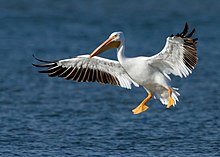
Great White Pelican - Wikipedia
Pelicans returned, I didn't feel I knew enough about this place to write about it. Like many things here I didn't understand what was going on. They came, they massed and then they were gone. Who knew what, or who would show up next? I'm sure there is still much to know but after living a full cycle I feel I just might have enough of a clue to start writing about this place and about our adventures here.

And so...back to the Pelicans. The pelicans here are the American White Pelican.  Much larger than the more common brown pelican they boast a 9 foot wingspan and live and breed in inland, shallow lakes, like Agency and Klamath.  The pelican's feeding areas (like the cove) are often miles from their breeding areas. (here I now suspect that's the Wood River Wetlands to our North). Over the last century their numbers have diminished but their presence in Klamath County remains strong. They are such an integral part of this area that they've given their name to countless other things. Across the lake from the house is Pelican Butte, to the East of which lies Pelican Bay.
Pelican Pete says "Hi"
The Klamath Union High School 's mascot is Pelican Pete. Pelican City, home to Pelican Lumber Company is between us and Klamath Falls.  There is also a Pelican Cinema, Pelican Senior Center, Pelican Signs, Pelican Elementary... you get the idea.

It is in the local tradition of naming everything after Pelicans and in the tradition of the Chinese zodiac that I have therefore named our first year here, the Pelican Year.


Monday, January 15, 2018

Settling In

It's 2018! Can't believe I haven't posted in 5 months!

Apparently, for all the adventures we undertake, SD and I are homebodies. Having a home, be it a van, tent, RV or an actual house, that we're happily settled into is a necessary prerequisite to regular blog post and adventure. Like mountaineers summiting a big peak, we need a Base Camp. And that Base Camp needs to be organized and manageable.

Here are just a few of the highlights from the five months of settling in and setting up our latest Base Camp.

First and foremost were the spider wars. We lost the first round. It was only the onset of colder weather that caused their retreat and is giving us time to prepare for next summer's onslaught. But when they were active, they were everywhere and according to Alyssa, we had all kinds. Our best defense will be daily soffit and web sweeping. If they can't build webs, they can't trap food. All I can say is that it's a good thing we're not scared of spiders.
Best Hardware Store Ever

Getting back into house cleaning was also an adjustment. It took only 30 long minutes to completely clean the trailer. It's been 5 months and I don't think this house has been completely cleaned ever. The good news is we discovered robot vacuums. Eufy is now one our best friends. In a little over an hour he picks up all the house dust and spiders too.

Finding the right stores was also an important part of getting settled. Aside from the Chiloquin hardware store, we spent the first months shopping in all the wrong places. It wasn't until after talking to the mattress salesperson that we started getting our groceries at Sherm's Thunderbird, wine at Rosterolla Wine, and our meat at Howard's Butcher Shop.

Our Puppy! aka Skunk Boy
Settling in has also meant learning about dead skunk management. Did you know a skunk can stink for up to 6 months after it dies? Yup. SD found one all dried up under the deck by the front door. It stunk, but since it was already desiccated he figured that if he buried it in the wood chip pile, it wouldn't stink and would be composted by spring. Skunk composting was going well until we got the dog. (And yes, getting a dog is key to settling down). When the wind blew off the pile, Terrence's little nose picked up something good. Despite our best efforts to deny him, one day, or rather one minute when I left him to move some firewood, he dug that think out of the pile and was joyfully running toward me with his desiccated prize. Thanks to the web we learned that a mixture of hydrogen peroxide, baking soda and dish detergent neutralizes the odor...until the dog goes back into the pile and pulls out another skunk scrap.

Getting back to work with all this excitement going on has also been a challenge. I've been extremely fortunate to have been asked back to work, virtually, from my old job. The project is great, the people too. But sometimes it's hard to sit at my desk while the spiders are just outside spinning their webs, the dog is running by with dead carrion and the weather and the view are breathtaking.

Have I mentioned the view? We still haven't adjusted to living in this place where every moment, in every direction is just more stunning and spectacular than the last. I hope we never will.

Settling in as we have over the last five months I've also come to realize it's not so much a view as a setting. Mt McLaughlin, Pelican Butte, the Mountain Lakes Wilderness, the Sky Lakes Wilderness, Modoc Rim, and Agency Lake, the sunsets, sunrises, rainbows, lightening storms, clear full moons, bright starry nights, it's more than just beautiful. They are all the stage, the setting for this adventure.

Now that we're settled in it’s time we can start exploring and writing about the wonderful places around us.

Tuesday, August 08, 2017

They're Just Here For the Sex

Cue the Barry White
It was less than a month ago, mid-July, that Dave and I moved into our new home. We closed on Tuesday and began moving our stuff in the next day.  Apparently we weren't the only ones moving in.  As we emerged from the truck swarms of bugs flew up from the grass, down from the leaves, and out from under the eaves of our dream home.  They hadn't been there for the initial showing, the house inspection or the final walk-through just two days ago. Now they were everywhere.
The previous home owner also happened to be there as well,
Roadside Attraction
hauling away her last load. She wasn't the least concerned about the bugs, "they're just here for the sex" she told us. Then drove away.

Well, the sex at our place must be awesome because the bugs are still here. Dave discovered that they are called Klamath Midges, that they don't have mouths (something he's assured both me and the guys replacing the septic system numerous times), that they generally live at the bottom of shallow lakes and indeed, they only come out
Through it all, the septic guys prevailed
once a year, for the sex.

Every night, just before dusk the whine begins. We couldn't believe it was the bugs making the high pitched whirling noise.  Certainly there were a lot of them, but the noise was loud, really loud. Then we saw the giant, black, morphing, spiralling bug clouds and we knew that we were witnessing the infamous Klamath Midge Mid-Summers Night Orgy.

The nights here are beginning to calm down. It may have
Kinda cute after all 
something to do with the flock of magpies that now arrive every evening just before dusk and hungrily feed on the midges, or it could just be that all midges have done their business.  Dave and I, on the other hand have lots more to do. Last night the full moon rose after a quiet, midge-less dusk. Dave and I sipped our wine, looked out across the Klamath Basin and thought....those bugs certainly know how to pick a romantic spot.

Monday, July 17, 2017

Home From The Range

View from the Front Yard: Klamath Lake
and Mt McLoughlin
Two months ago, on May 18th in Colorado, we sold the trailer. The plan was to head up to Southern Oregon and spend the next year looking for a place to settle down.  It'd taken a little more than a year to find our last house in Beverly, MA. so we figured on the same time to find our next home.  While our criteria this time was extremely different this time too we suspected the hunt would be long.

May 26th we arrived in Klamath Falls, Oregon and went to look at our first....and last house.

The reason I haven't posted in over two months isn't because nothing has been happening. It's because something so awesome has been happening that I didn't want to jinx it by posting.

Today we closed on our new home, the photos (these photos are by a professional that the realtor had taken to sell the house) tell more of the story than I will ever
Home
be able to, but I will say that this home is more than we had ever dreamed of. And that dream was a big one.

We wanted a home and land but we didn’t want to give up the “wildness” that we’d come to love.  In Ash Meadows, NV we'd grown to love the wide, dark night sky.  Tracking the progress of the month through the phases of the moon. Loving both the full moon nights where the sky and land are illuminated and the new moon nights of unimaginable depth.  In Alaska, at the Tetlin National Wildlife Refuge, we grew to love and know the countless birds and ducks on Deadman Lake and never ceased to be amazed by the views of far off snow covered peaks.  In Jacksonville, Florida we lived less that 300 yards from an eagles nest and watched two young eagles as they hatched and grew. In Texas we hiked miles and miles into the National Park, loving the remoteness, the deer, elk, javalina, bears , mountain lions, and again, the darkness of the night sky.

View from the Living Room
Somehow we hoped we could find a home that would incorporate all this. We knew it was dream. How could there possibly be a place with all of that? A house that provided just not shelter but inclusion in nature. Expansive views of mountains and sky. Eagles, birds and wildlife for neighbors. Space for animals and southern exposure for gardens and trees.

Our new home has all this and more.  We'll certainly be posting more now that our new adventure is beginning but we wanted to share the good news and also invite all our friends to visit anytime.  There's a beautiful guest room, and or a place to park your RV, just waiting for you. Hope to see you soon!
The Kitchen!

Saturday, May 13, 2017

Cow or Car?

We're on the road again! Traveling from Guadalupe MNP to central Colorado where we'll sell the trailer, then on to Oregon.  On the way we plan to stop at a few more National Parks, some cute towns, some quirky roadside attractions and have a few more adventures.

For the first hour and a half of the adventure, however we played the uniquely western car game, "Cow or Car?".   Each participant has to guess whether the next thing in road will be a cow or a car.  The rules are simple.  The car has to be moving, the cow does not, but it does have to be within 20 feet.  Although they are usually in the road, which does make coming around a tight corner interesting. 

For the first round we both guessed cow and sure enough with 15 minutes there was a cow, actually a momma cow and her calf in the road.  For the next round I stuck with cow, S.D. went with car.  10 minutes passed and then a car passed and S.D. pulled into the lead.  For the next round I switched to car, S.D. to cow.  We were nearing the town of Queen (pop. 32), it was morning and the cafe (the only business in town) was open so I thought it was a safe bet. Nope.  We passed a cow just as we came into town.  None of the cars moved.  This excitement continued for another hour until S.D. was ahead by 6 points and I quit.  There should have been a car somewhere but it was all cows.  And "Longhorn Alley" was still 20 mintues away.

Yes, life on the road isn't just non-stop excitement. There are some truely boring moments, even hours. 

Saturday, April 29, 2017

Apex Predators and Their Lunches

There is a deer up there, on the left, I promise.
Meanwhile - back on the trail in Dog Canyon....

Less than five minutes after we watched the mule deer lay down under the only juniper tree on the mountainside across the canyon, a large brown shape moved in the bushes 50 feet above it. S.D. had been wanted to see a mountain lion ever since we arrived at Guadalupe Mountains.  I was not thrilled by the idea of running into one on the trail but seeing one on a far off mountain-side while we enjoyed our lunch, was an acceptable option.

The brown shape above the mule deer moved again. It lept out of the shrubs and onto a rocky ledge. We coud see clearly now that it was a mountain goat.  The mountain lion sighting would have to wait.
Turkeys (aka Mountain Lion Lunch)

We knew they were out there.  The Dog Canyon Ranger had a camera at the local (hidden) spring and he had lots of mountain lion photos.  Bears, deer, javalina and other animals came to the spring too, it was the only reliable water source for miles. But it was the abundance of mountain lions that was so impressive.

Apex predators are the top of their food chain. They're the animal upon which no other creatures prey. Man is the ultimate predator, provided he has a gun.  Without a gun, and they are illegall in most National Parks, man moves down the chain.  Here in Guadalupe Mountains National Park that puts mountain lions at the top, the apex predator.  It's also puts us humans, on the lunch menu.

For the last three weeks we've been working on the Tejas trail.  The trail passes within a quarter mile of that very popular spring and not wanting to be someone's lunch, I'd been hyper alert to mountain lion signs.  Working on that section I felt a little like the deer look.  Extremely nervous, always alert, skittish at every sound.  We saw deer, and turkeys, we saw a whole family of javilinas, and lots of ringtail prints, but we didn't see any lions. Not even a paw print. Feeling pretty safe, and also very curious, we decided to see if we could find the spring, and perhaps a mountain lion or two.

Still Watching (image from
wikipedia)
Following a game trail, and then even an old wagon road, it only took 20 minutes or so to locate the spring. Considering it was the middle of the day, and we'd been crashing through brush to find it, there weren't any animals, let alone mountain lions.  We did even see prints. But there, at the bottom of the canyon, at the turn of a huge wash you could feel them watching us.

It's been a few weeks since we visited the spring, we still haven't see any mountain lions but something tells me they're still watching.

Wednesday, April 12, 2017

The Next Step in the Adventure - The Trailer is For Sale!

Off to New Adventures
 After two years on the road, S.D. and I are ready for the next phase of the adventure.  Our original plan was to spend three years on the road, the last year of which we would spend focusing on the area(s) were we wanted to settle down again.  We've had a great time exploring but now it's time to start looking for a place where we can put all the cool things we've learned over the past years into practice.

Our first step - sell the trailer. The Outdoors RV Creekside 20 FG has benen perfect fortraveling. Well built, nicely layed out, and equiped with everything we need. What it didn't have, the solar panels, water pressure tank, etc. S.D. has added. It has been maintained to the highest standard and except for a few dings here and there is like new.  We're going to miss it but in order to really get to know an area well however, we feel it will be best to rent somewhere and get more of a feel for the town and area than we can do from a campsite and trailer situation.
We Cooked Up Alot in the 20FQ Kitchen

Which brings us to the second step. Picking the town/area. What we're looking for is a place where we can live sustainably, still have lots of outdoor adventures and be part of progressive community, and a local economy.

Specifically this is a place where we can garden, growing much of our foods, etc. One thing we've really missed on the road is gardening and our bees.  We'd love to get back to growing and eating our own food.  Maybe even add some hunting and fishing.

We'd also like to stay off the grid (if possible).  Living in the RV, especially after S.D. installed the solar panels has given us a taste for keeping a small footprint and we'd like to continue with that.

We're also looking for a place that's quiet and dark at night.  Where we can have either a lot of land or at least five acres and be out of town near state or federal land. We'd like to continue hiking, and get back to bicycling so this area shoud have those opportunities. 

Mountains, Lakes and Land!
At the same time this place should be within an hour or two of a nice town. Ideally this town would offer some cultural benefits, perhaps some employment opportunities and have a local economy.  Other folks that are making or growing stuff and supporting each other's efforts.

We'd also like it to be close to family.

Put all that together and right after we finish our gig here at Guadalupe in Mid May,  we'll be headed to Central, Southern Oregon in early June!

Friday, April 07, 2017

The Art of the Trail - 4.2 Miles to Guadalupe Peak

View From the Top - Texas and Mexico
The highest point in Texas is Guadalupe Peak.  Located on the far end of an ancient coral reef that became a mountain range.  Rising 3000 ft above the permian basin, Guadelupe Peak tops out at 8752 ft.

The hike to the peak is 8.4 miles round trip.  Climbers ascend the 3000 ft in 4 miles, making it a strenous hike that hundreds of people walk each year.  To some it's an easy day hike, to others it's the opportunity to hike the highest peak in their state, to some it's a religious pilgrimage. To S. D. and I, it was just one of the many trails we had to hike while volunteering at Guadalupe Mountains National Park.  What it unexpectedly turned out to be also was a day of trail building appreciation.  I have never hiked a more artfully constructed trail. It is beautiful!

First off there is the design/route of the actual trail. This trail isn't used only by avid hikers. 
There's even a bridge - 3 miles up
Many of the folks we saw didn't look like they had ever walked 8.4 miles, let alone up a mountain. We assumed some were climbing for the bragging rights.  Then there was a very frail woman and her family that we met near the summit.  They, like others, climbed (or rather inched their way up ) Guadalupe as a religous pilgramage. The mountain is named after our Lady of Guadalupe, whose image can be seen in the mountain's profile. Climbing the mountain, it is believed, bestows blessings on the pilgrims. The shear numbes of hikers provides a challenge for the trail designers; how to construct a trail up and around the sides of a very steep mountain that is walkable, sustainable and able to stand up to the impacts of all those hikers. The answer - a two person-wide width trail with well constructed steps (when necessary), and lots of gentle switchbacks.

Trail Through the Forest
The second amazing thing about the trail are the views. This is one of those trails where every foot up (or down) is breathtaking, and every 1/2 mile or so, completely different. The trail seems designed to highlight each and every one of those views and ecosystems. On the way up you first rise up through Pine Canyon with ever expanding views to the East and over the Chihusha desert. By the beginning of the second mile the trail switchbacks through a wonderfully cool Pine Forest then through a small pass and meadow. Then it's up over a short rise and the views for the last mile are now to the West, out over El Capitan.  The Peak view is 360 degrees out over New Mexico, Mexico and Texas.

As S.D. likes to say "hiking up the mountain is hard on your lung, hiking down is hard on your knees." Not so much on this trail. Going down is just as gentle as a 3000 ft descent can possible be, and since we're weren't sucking wind, we had even more time to appreciate the views and the trail.